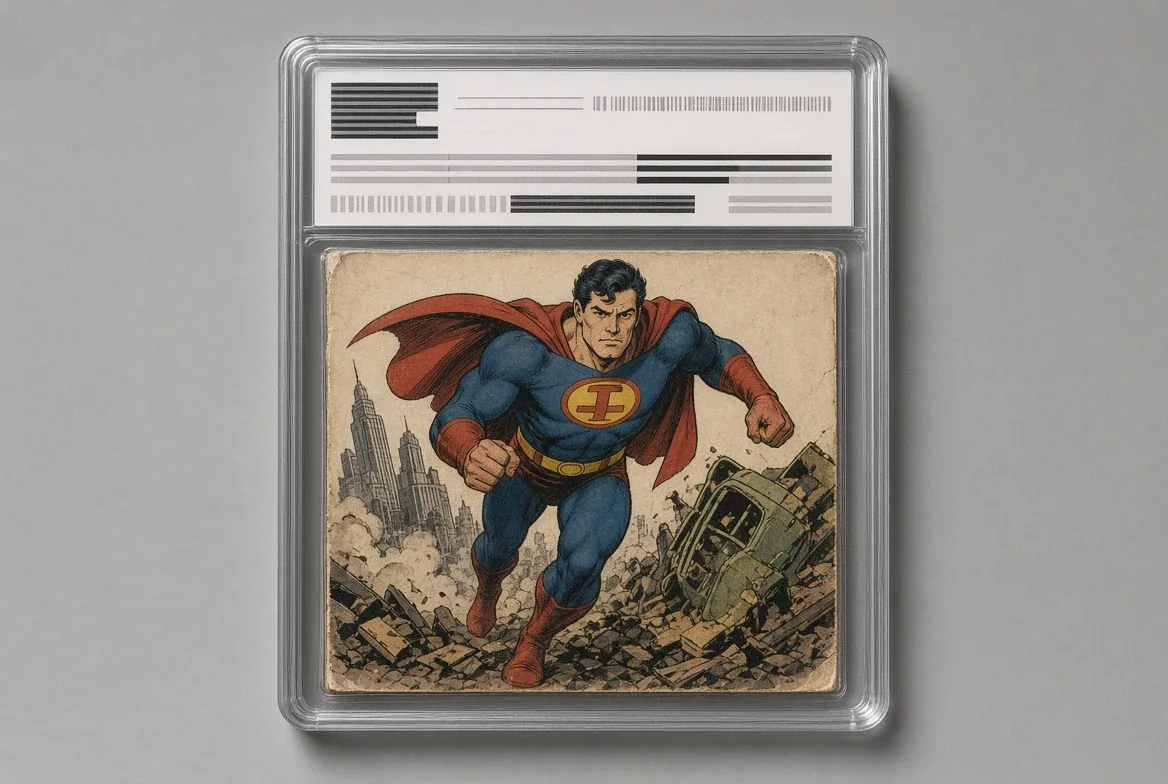
Comic book grading is the third-party process in which a certification service examines a comic, assigns it a number on a 0.5-to-10.0 scale, and seals it in a tamper-evident holder. CGC's published scale runs from 0.5, labeled Poor, to 10.0, labeled Gem Mint, and the company says the final number is a consensus reached by several graders rather than one person's opinion.
Grading now sits at the center of how vintage and modern comics change hands, and the label has become the shorthand the market reads before it reads the book. The mechanics are less mysterious than the mystique suggests. A slab carries at least three separate judgments — condition, paper, and whether the book has been worked on — and each one is measured on its own scale, by its own criteria, with its own limits on what it claims.
What does a number on the 10-point scale actually mean?
It describes physical condition, and nothing else. According to CGC's published grading scale, graders weigh manufacturing defects, handling damage, wear and eye appeal across a range running from 0.5 to 10.0, in fractional increments that narrow sharply at the top of the scale.
The compression at the high end is the part newcomers tend to miss. CGC's criteria place a 9.8 at negligible handling or manufacturing defects, while a 6.0 is described as showing a major defect alongside some smaller ones. Between those two numbers sit roughly a dozen distinct grades, each meant to capture a difference a trained eye can see and a casual one usually cannot.
| Grade range | Label range (CGC) | What the range describes |
|---|---|---|
| 10.0 | Gem Mint | No defects |
| 9.9–9.2 | Mint to Near Mint | Near-perfect condition |
| 9.0–7.5 | VF/NM to VF- | Very fine, well preserved |
| 7.0–5.5 | FN/VF to FN- | Fine condition |
| 5.0–3.5 | VG/FN to VG- | Good to very good |
| 3.0–1.8 | G/VG to G- | Good, with significant wear |
| 1.5–0.5 | Fair to Poor | Heavily defaced, missing pieces |
The abbreviations are trade shorthand carried over from decades of collector usage: VF for very fine, FN for fine, VG for very good, with slashes marking books that fall between two established tiers. The scale is a description of a physical object on a particular day, not a judgment about the book's importance, its print run, or what anyone should pay for it.
How does a comic actually move through the grading process?
It moves through a fixed sequence of handling steps, most of which have nothing to do with grading. CGC describes a seven-step procedure in which the grading itself is a single stage, bracketed by verification, authentication, encapsulation and quality control — a workflow built as much around chain of custody as around condition.
- Receiving and verification: packages are opened under security cameras and contents checked against the submitter's paperwork, with each item assigned a barcode for tracking.
- Authentication: the item is assessed for genuineness before any grade is considered.
- Grading: multiple graders enter a grade into CGC's system, and a consensus is reached on the final number.
- Encapsulation: the comic and its label are sealed into an archival holder using sonic sealing, with anti-counterfeiting features.
- Quality control: specialists inspect the holder, the label and the certification details.
- Packaging: items are counted back against the original paperwork.
- Shipping: books are individually packed and returned to the submitter.
Not everything submitted comes back in a holder. CGC says items that are too fragile, oversized, explicit, or that have mismatched covers may be rejected, with the fee refunded minus processing charges. The rejection categories are a useful map of the service's boundaries: it certifies what it can safely handle and confidently identify, and declines the rest.
Why is page quality graded on a separate scale?
Because paper ages on its own timetable, independent of how carefully a book has been handled. CGC runs a separate page quality scale, from white through to brown and brittle, alongside the numeric condition grade — a cover can survive fifty years in near-perfect shape while the interior stock underneath it darkens.
The underlying chemistry is a preservation problem rather than a collecting one. The Library of Congress, in its guidance on the care of works on paper, notes the acids inherent in works on paper, especially as paper ages, and recommends alkaline buffered storage materials for their neutralizing effect. Nothing on a grader's desk reverses that process; the page quality designation simply records where a given copy currently stands.
This is why two copies of the same issue can carry the same number and trade as different objects. The condition grade and the page designation answer different questions, and a collector reading only the large number on the label is reading half the label.
What does the restoration scale on a label describe?
It describes work done to the book after publication, measured on two axes at once. CGC's restoration grading scale rates restoration by aesthetic quality, on an A to C rating, and by quantity, on a scale of 1 to 5 — so a label can record both how well the work was executed and how much of it there is.
Separating quality from quantity is the significant design choice. A single skillfully executed repair and an extensively reworked book are different propositions, and a one-dimensional flag would collapse them into the same category. The two-axis notation keeps them distinguishable on the label itself, without requiring the reader to take anyone's word for the difference.
Does a population report tell a collector how rare a book is?
No, and the service that publishes one says so directly. CGC's population report tracks the number of comics, magazines, pulps, concert posters and lobby cards the company has graded, sorted by publisher, title and issue — a count of submissions received, not of copies that exist.
The disclaimer on CGC's own census page is unusually blunt for a market-facing document: census data are not an indicator of value or rarity, and are offered as a resource for hobbyists' informational use only, not to be relied upon for making a purchase or an investment. A population figure moves every time someone mails in a box. It is a caution the market does not always observe.
How should a collection be stored before it is ever submitted?
In conditions that slow the chemistry down. The Library of Congress recommends a cool environment at room temperature or below, relatively dry at about 35 percent relative humidity, clean and stable, with protective enclosures made from acid- and lignin-free materials and acidic items isolated to prevent acid migration.
The isolation point is the one most often skipped. The Northeast Document Conservation Center, in its storage and handling leaflet, notes that acid migrates from chemically unstable paper to any other paper it touches directly, and advises enclosing ephemera individually for that reason. A comic stored in direct contact with an aging backing board or a stack of newsprint is sharing the problem, not containing it.
None of this is grading, strictly speaking. But a page quality designation is the outcome of years of storage decisions made long before a submission form is filled out, and it is the one line on a label a collector still has some influence over.
For a related collecting perspective, read How Does CGC Grading Work? A Collector's Guide to the Comic Grading Scale.
For more context, read Where to Start With Batman: A No-Spoiler Reading Order.