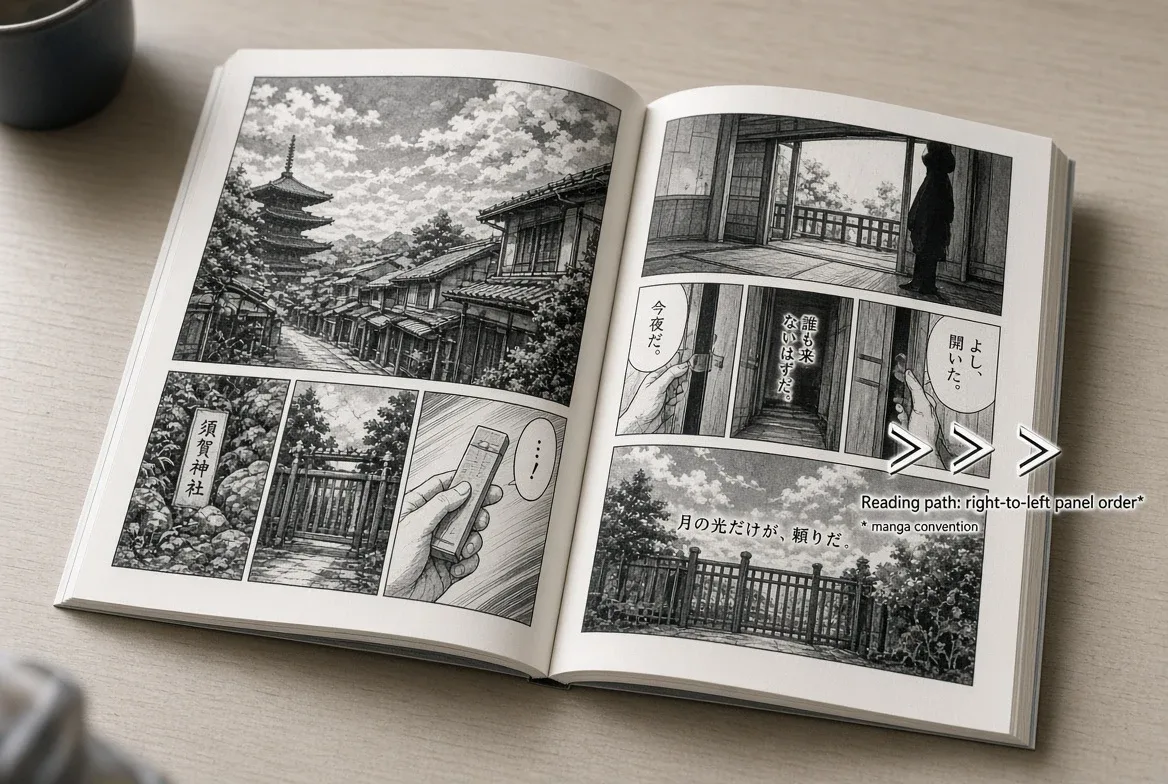
American manga publishers print most titles in their original right-to-left page order, spine on the right, because flipping the art to run left to right disrupts the panel-to-panel action the artist built into the layout. VIZ Media, one of the largest English-language manga publishers, states on its company FAQ that reading right to left "maintain[s] the flow of action from panel to panel and page to page as it was originally intended by the artist, or mangaka." The practice became the industry default in English-language publishing over the 2000s and has held even as manga's U.S. sales have grown sharply.
The question comes up constantly among new readers picking up their first volume: why does a book meant for an English-speaking audience open from what looks like the back? The short answer is that manga panels are drawn and sequenced for right-to-left eyes from the first sketch, and reversing the page mirrors every panel, every gesture, every sword swing, along with it. Unflipping — printing the artwork exactly as drawn and adapting only the lettering — became the standard fix once publishers judged that mirroring cost more storytelling than it saved in reader convenience.
What actually happens when a manga page gets "flipped"?
Flipping means mirror-reversing every page so panels run left to right, the way English books read. Early English-language manga in the 1990s did this routinely, and it seemed like a simple production step: reverse the film, keep the story, ship the book. In practice it reverses everything else on the page along with the reading order.
A mirrored page swaps left-handed characters for right-handed ones, reverses which direction a punch or a blade travels, and can put a car's steering wheel on the wrong side of the road. Scars, insignias, and clock faces flip too, and a character established as right-handed in one volume can read as left-handed in the next if a flipping decision changes partway through a series. None of that is a translation choice; it is an artifact of the mirroring process itself, and manga readers and letterers spent years cataloguing the small continuity breaks it produced before publishers moved away from the practice.
Why do publishers say the original panel order matters this much?
Because the sequence and pacing of panels is where a manga artist builds tension, comedic timing, and the sense of motion between static images, and that sequence is oriented to a right-to-left reading path from the layout stage onward, not adjusted after the fact. According to VIZ Media's company FAQ, preserving that order keeps the "flow of action" as "originally intended by the artist."
A page built for right-to-left reading often uses the gutter between panels, and the reader's eye path across a spread, to set up a reveal or a beat of comic timing: a wide establishing panel in one upper corner, a tight reaction shot tucked opposite it, a final beat isolated at the bottom of the page. Mirror the page and the eye still moves left to right by habit, but it now crosses panels in an order the artist never drew for, which can flatten a punchline or blunt a reveal the layout was built to deliver.
How does lettering adapt to a right-to-left page without redrawing the art?
Unflipped publishing shifted the adaptation work from the artwork to the text. Instead of mirroring panels, letterers translate dialogue and reset it into the existing balloons, following the same right-to-left, top-to-bottom order the original Japanese lettering used, so a reader's eye still lands on the first line of dialogue the artist intended to be read first.
Sound effects drawn directly into the artwork present the harder case, since they are part of the illustration rather than a separate text layer; many publishers either leave them in the original Japanese with a small translated gloss nearby or redraw them in English within the same panel space, a workaround built specifically to avoid disturbing the surrounding art. Cover logos and honorifics in character names raise similar case-by-case calls, handled title by title rather than under a single fixed rule.
Did storytelling convention itself change once manga reached a wide U.S. audience?
Manga's storytelling conventions were already exerting influence on American comics well before unflipped publishing became standard. NPR's retrospective on comics that reshaped the medium credits Osamu Tezuka's Astro Boy, first published in Japan in 1952, with an approach whose "visual style, action, and character-based storytelling became hallmarks of manga" that later spread internationally through both the comics and the animated adaptation.
That character-first, motion-driven page construction is part of what English-language publishers were protecting when they moved away from flipping. Preserving the original page order was not only about respecting an artist's layout; it also let the pacing techniques that helped make manga distinctive, extended wordless action sequences, decompressed panel rhythms, cinematic camera distance shifts between panels, travel intact into a new market rather than being smoothed into Western comics conventions.
Has the format held up as manga's American readership has grown?
Unflipped, right-to-left publishing has remained the norm through a period of significant sales growth, evidence that the format has not been a barrier to new readers. Manga sales in the United States roughly quadrupled between 2019 and 2022, reaching about 28.4 million copies and becoming the fourth-largest fiction category in the country behind romance, thrillers, and fantasy, according to a PBS NewsHour report published May 18, 2024.
That report quoted Shannon DeVito, Barnes & Noble's senior director of books, describing demand so strong that "we couldn't fill the stores fast enough," and noted that readers were rereading series and actively seeking out more titles rather than sampling and moving on. None of the growth drivers PBS identified, including manga apps, streaming anime, and crossover cultural moments, involved abandoning the original page order; the format scaled with the audience rather than being reworked for it.
What should a new manga reader actually do with the book?
Open a right-to-left manga volume from what looks like the back cover of a Western book, and read panels within each page from the upper right corner toward the lower left, following the same path the original Japanese edition uses. Most English editions include a short reading-direction guide on the first page for exactly this reason.
Speech balloon order follows the same right-to-left path within a panel, so the sequence of who speaks first typically runs opposite to the instinct an English-language reader brings from prose books or Western comics. Publishers rely on that printed guide, rather than a redesigned layout, to bridge the gap for first-time readers, and most readers report the adjustment takes only a volume or two.
| Approach | Page order | Trade-off |
|---|---|---|
| Unflipped (current standard) | Right to left, original panel layout | Preserves artist's intended action and pacing; requires a brief adjustment from new readers |
| Flipped (common in the 1990s) | Mirrored to left to right | Familiar reading direction; mirrors handedness, weapon direction, and other layout details |
The trade-off publishers settled on favors the artist's original construction of the page over a familiar reading direction, on the reasoning VIZ Media has stated publicly: the panel order is not incidental to the story, it is part of how the story is told.
For a related comics news perspective, read How Comic Book Grading Works: The 10-Point Scale, Page Quality, and Slab Labels.
For more context, read Where to Start With Batman: A No-Spoiler Reading Order.