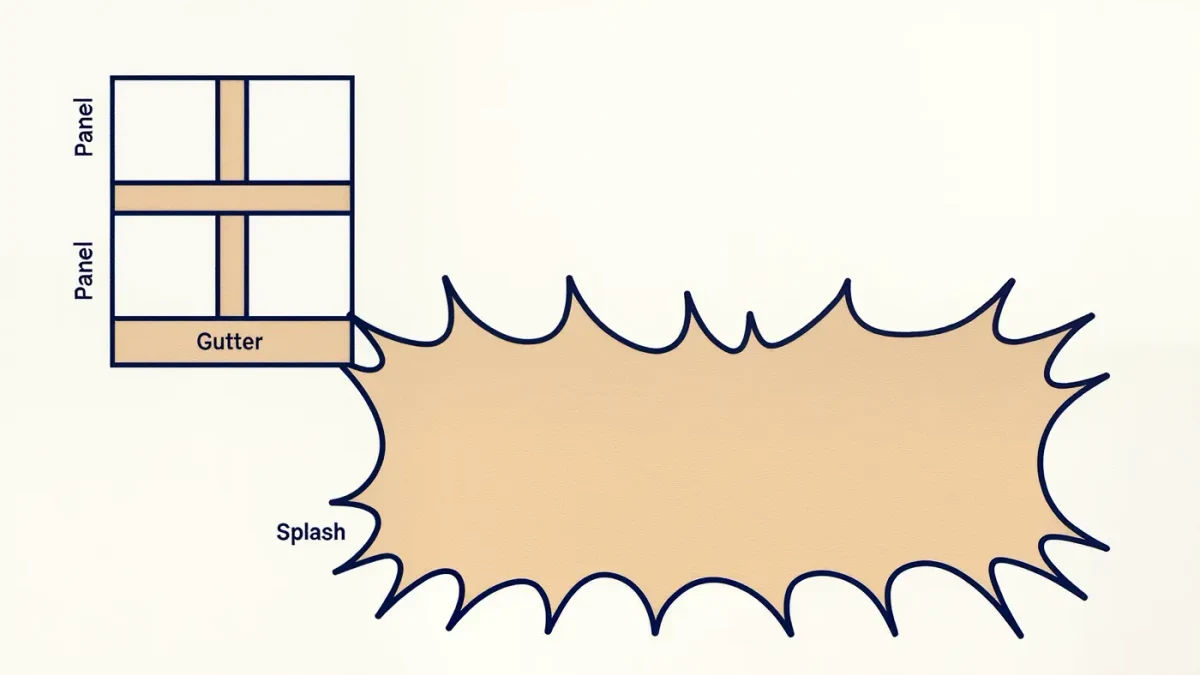
Comics grammar is the machinery you already read without noticing. The panel is the frame, the gutter is the gap between frames, and the splash page is the full-page statement — and together they form a language with real grammar, systematically mapped in cartoonist Scott McCloud's Understanding Comics (1993), a best-selling analysis still standard reading in comics programs three decades on. Knowing the vocabulary changes how pages feel: suddenly pacing is visible, tension has a layout, and the white space between panels becomes the place where you, the reader, do half the work.
What is a panel actually doing?
Three jobs at once. A panel frames time — its borders decide how long a moment lasts. It directs attention — panel size and position steer your eye across the page in a reading order artists choreograph deliberately. And it sets rhythm — a page of small tight panels reads fast and clipped; a sequence of larger ones slows the eye down. When a creator shrinks the panels during an argument and stretches them across a quiet reunion, that is pacing doing emotional work. You have been hearing it your whole reading life; the vocabulary just names the instrument.
Why is the gutter the most important part of the page?
Because the story happens there. Between two panels, time passes, movement occurs, and cause becomes effect — but the comic never draws it. McCloud called this closure: the reader's mind fills the gap, inferring what happened between frames. This is why comics feel participatory in a way film does not. Film shows you every step at 24 frames a second; comics show you two steps and make you walk the distance yourself. Skilled creators exploit this constantly — the harder the cut between panels, the more the reader must invest to bridge it, and the bigger the payoff when the gap closes into a reveal.
What is a splash page for?
Emphasis at maximum volume. A splash — a single image occupying a whole page — stops the reading rhythm cold and says: look. Classic uses are the opening statement of a story, a fight's turning point, a marriage, a death, a transformation. Its power comes from scarcity: splash pages work because they interrupt a grammar of panels. A double-page spread goes further, giving one moment the real estate of two pages. When a run you love hits its emotional peak on a spread, that is not decoration — it is the sentence structure of the medium peaking on purpose.
What other grammar rules should readers know?
A short toolkit covers most pages:
- Panel shape. Tall panels suggest height or isolation; wide ones, landscape or time stretching; tilted ones, instability.
- Word balloons and captions. Balloons carry speech in the present; caption boxes carry narration, memory or time jumps. Lettering style is performance — a jagged balloon is a different voice than a round one.
- Page turns. In print comics, the right-hand page's last panel is a stage curtain: creators place reveals on the far side of the turn for a reason.
- Reading order. Left-to-right, top-to-bottom in Western comics; manga's right-to-left order is why reading it "backwards" is actually reading it correctly.
Does this vocabulary differ between comics and manga?
The core grammar is shared — panels, gutters, closure — but the dialects differ. Manga tends toward more, smaller panels with freer layouts, heavier use of silent sequences and symbolic visual shorthand for emotion; mainstream American comics historically lean toward larger figures, denser caption narration and more regular grids. Webcomics and webtoons add their own dialect: the vertical scroll replaces the page turn, so pacing is built around continuous downward flow and spacing between panels does the gutter's work. Different dialects, one language — which is why a reader fluent in one can learn another quickly.
Why does knowing comics grammar make reading better?
Because it turns instinct into appreciation. You stop only following the story and start seeing the storytelling: why an artist held that splash until issue four, why the gutter between those two particular panels is wide, why the letterer changed balloon shapes for one character. It also makes you a sharper critic — you can say why a page works, not just that it did. Institutions take the grammar seriously too: the Library of Congress's cartoon and comic art collections preserve original boards precisely because the drawn decisions — panel borders, margin notes, corrections — are the language itself. Read one run afterward with the vocabulary in mind and pages you know well will start talking. They were always talking; now you can hear them.
For more context, read How Did Public Libraries Become Comics' Biggest Gateway?.
For more context, read What Was the Comics Code Authority, and Why Did It End?.
For more context, read How Do You Collect Comics on a Budget? A Reader's Guide.