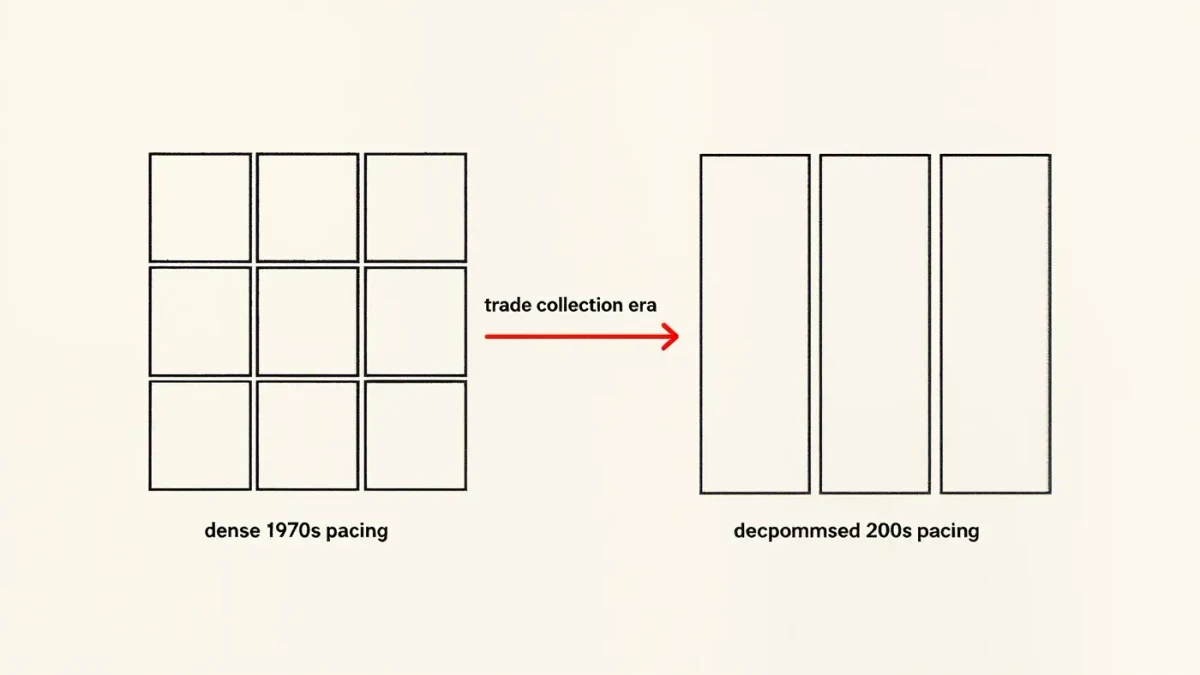
The rule that holds up: buy trade paperbacks for reading and one omnibus for the single series you actually reread. The oversized hardcover omnibus — roughly 1,000-plus pages of sewn-binding material at a list price that has climbed into the $100–$125 range on new Marvel and DC editions as of 2025 solicitations — is a commitment purchase whose value depends entirely on rereading. Per publisher catalog data, a comparable run in standard trades typically costs less per issue at release but sprawls across a shelf; the format decision is really a decision about your own habits, not about the comics.
This guide compares the collected-edition formats on documented dimensions — trim size, binding, durability and per-page economics as of 2025 publisher listings. It publishes format guidance, not collection appraisals.
What are the formats, in one table?
| Format | Typical scope | Binding / size | Shelf verdict |
|---|---|---|---|
| Trade paperback | 4–8 issues | Glued, standard size | The reading default |
| Deluxe hardcover | ~12 issues | Sewn, oversized | Best value hardcover |
| Omnibus | 20–50+ issues | Sewn, oversized, heavy | Reread-only purchase |
| Compendium | ~48 issues | Glued paperback, phone-book size | Cheapest per page |
| Library edition | ~9 issues | Oversized HC, archival paper | Series with premium art |
| Manga omnibus (3-in-1) | 3 tankobon | Glued, digest size | Binge series saver |
Why is the omnibus a reread-only purchase?
Math and weight. A 1,000-page omnibus at the $100–$125 list-price range of current Marvel and DC solicitations works out to roughly ten cents a page; the same material often appears in Epic Collection–style paperbacks or digital editions meaningfully cheaper per page — Marvel's Epic Collection line was created precisely to reprint long runs affordably, per the publisher's own positioning. What the omnibus uniquely offers is oversized art reproduction, sewn bindings that survive rereads, and the single-volume convenience of not shelf-hopping mid-story. If you will genuinely reread the run twice, that premium buys itself in durability. If you won't, it buys a brick.
When is the deluxe hardcover the smarter buy?
Most of the time, for hardcover people. Deluxe editions — roughly a dozen issues of oversized, sewn-bound material in the $35–$50 range as of 2025 solicitations — hit the sweet spot: significantly upgraded art size and durability over trades, without omnibus cost, weight, or the out-of-print risk that makes some omnibuses appreciate into absurd used prices. Publishers including DC, Dark Horse and Image all run deluxe lines; Dark Horse's Hellboy library editions are the format's showcase example, pairing oversized art with supplemental material.
What are compendiums actually good for?
Binge economics. The compendium format — pioneered at scale by Image's Walking Dead line, with each book collecting roughly 48 issues in a glued phone-book paperback — delivers the lowest cost per page of any print format, per the publisher's listings. The trade-offs are real: glued bindings crack under repeated openings, the trim is standard not oversized, and the books are physically unwieldy. The correct use case is a long completed series you intend to read once, fast, on a budget. For a weekly-reread favorite, they are the wrong tool.
Do manga 3-in-1 editions hold up?
For binge reading, yes; for permanence, no. A 3-in-1 omnibus collects three Japanese tankobon volumes in one glued digest for less than the sum of the singles — Viz's long-running 3-in-1 lines are the template, and per the publisher's catalogs they exist precisely to lower the entry cost of long shonen series. The glued spine and thinner paper are the compromise. If a series is a lifetime keeper, the individual volumes or premium hardcover lines age better on the shelf.
How do you decide format in the store?
- Ask the one question that matters: will I reread this? No — trade or compendium. Yes — deluxe or omnibus.
- Check the binding term in the solicitation: sewn bindings (most omnibuses, deluxes, library editions) survive rereads; glued (trades, compendiums, 3-in-1s) is a one- to five-read lifespan.
- Compare per-page cost within the same trim size only — oversized pages are not the same product as digest pages.
- Weigh out-of-print risk: omnibuses go dormant between printings; trades and Epic-style lines are reprinted continuously.
Format notes, not story notes — no spoiler line needed for this one.
The compressed verdict: trades to read, deluxe hardcovers to keep, one omnibus for the series you reread every couple of years, compendiums for one-time binges, and 3-in-1s to catch up cheap. Every claim above traces to publisher solicitations from 2025, so you can verify prices and specs at the listing before you spend.