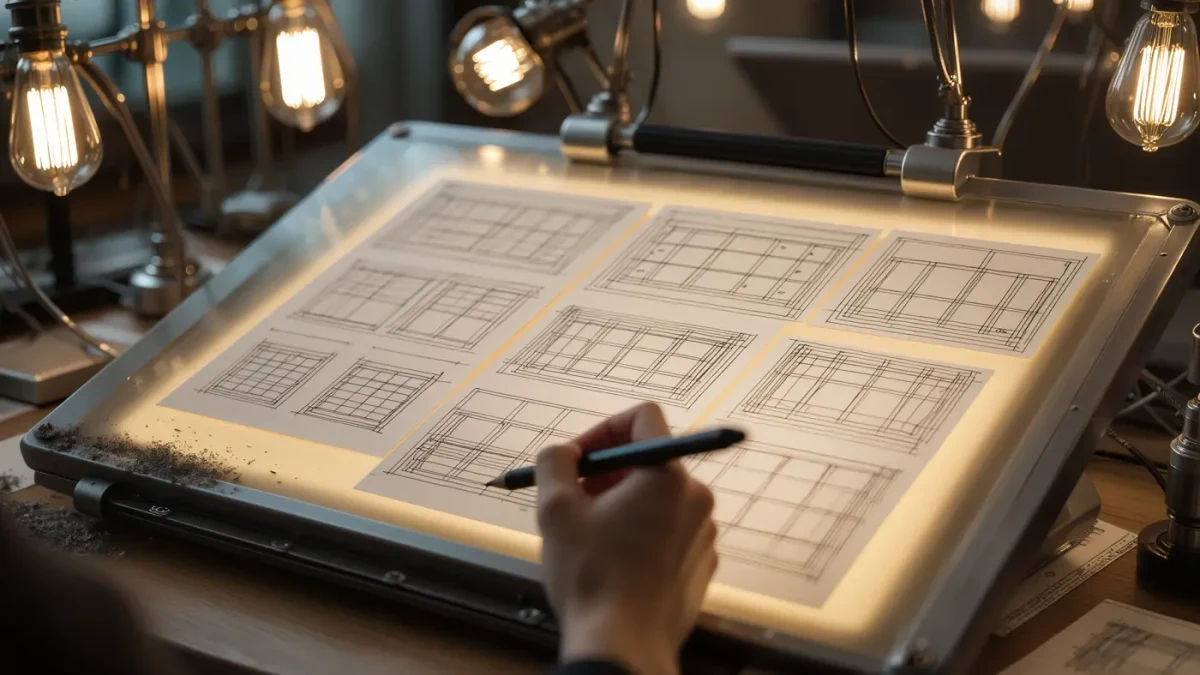
An animated season takes roughly 12 to 24 months from first script to finished episode, with a single 22-minute episode passing through more than a dozen departments along the way — per BBC Culture's reporting on animation production, even fast turnaround shows budget many months per episode once overseas studio time is counted. That's the short answer. The long answer is a pipeline that explains why your favorite show's seasons arrive when they do, and why animation news breaks years before air dates.
SSS Comics publishes explainers drawn from documented production practices — individual studios' schedules vary, and deadlines shift constantly.
Why does animation take so much longer than live action?
Because nothing exists until it is built. A live-action show films what a camera can see; an animated show must design every world, character, prop, and performance from a blank file. Where a sitcom shoots an episode in a week of filming on top of weeks of writing, an animated episode spends months in storyboards, more months in animation, and only then reaches post-production.
That's also why renewals and announcements feel strange to fans: a studio often greenlights a season a full two years before you can watch it, because that's how long the machine needs to run.
What are the actual stages of production?
Every studio's workflow differs in the details, but the spine is consistent across the industry:
- Development and writers' room. Premises become outlines, outlines become scripts. Rooms map the whole season's arc before individual episodes go to draft.
- Voice recording. Actors typically record early, often before final boards exist, so animators can draw to the performance. Lines are frequently patched and re-recorded later as scenes change.
- Storyboarding. Artists translate the script into drawn shots — effectively the directing stage, deciding camera angles, staging, and pacing.
- Animatic. Boards are cut together with scratch or final audio into a timed video. This is where an episode's rhythm is proven or reworked.
- Design and build. Character, prop, and background designers create the visual library the episode will draw from.
- Animation. The heavy lifting, often handled by partner studios overseas, turns approved boards into fluid motion — historically the longest single stage.
- Compositing, lighting, and FX. Layers are combined, lit, and polished frame by frame.
- Editing, sound mix, and delivery. Final picture lock, music, effects, and the master file that reaches your screen.
Why is so much animation made overseas?
Labor economics. For decades, Western studios have contracted animation itself to studios in East and Southeast Asia, keeping writing, design, and direction in-house. The model dates back to the 1970s and 1980s, when Japanese and later Korean studios took on contracting work for American television. That division still shapes credits you see today: a show's main titles name the creative team, while the end credits roll through the names of artists at overseas partners.
The consequence for viewers is invisible until it isn't — when a global disruption hits, production timelines slip in ways that no writing room can fix, because the bottleneck is thousands of miles from the writers.
What does a showrunner actually do on an animated series?
Same as in live action, plus a second job. The showrunner runs the story side — hiring the room, approving scripts, protecting the season's arc — and also functions as the final approval layer for visual decisions: boards, designs, and cuts pass their desk. In animation the role is closer to a comics writer-artist team's editor-in-chief, keeping story and picture telling the same tale across departments that never share a building.
Why do episodes of some shows look inconsistent?
Because episodes are made in parallel, often by different teams. A season's episodes overlap in the pipeline simultaneously, with separate storyboard directors and overseas units each bringing slight stylistic differences. Consistency comes from the design bible — the reference library of models, colors, and rules — but under deadline pressure, variance shows. Fans comparing episode-to-episode animation quality are really watching the schedule breathe.
How do streaming seasons differ from broadcast ones?
Broadcast animation was built around a fall-to-spring calendar and weekly drops; streaming seasons are often delivered whole, which changes production accounting — a full season must be complete before launch, concentrating risk at the end of the pipeline. It also changes arc structure: writers' rooms for streaming shows can plan a single ten-episode movie-like shape rather than stretch across 20-plus broadcast episodes.
That's why a bingeable season feels denser than the broadcast shows you grew up with. It was designed that way, from the first document in the pipeline to the last render.
What does all this mean when you read animation news?
Translate announcements on a two-year clock. A renewal today means scripts tomorrow, boards next quarter, and episodes reaching your screen after that. When a studio announces a premiere date, the work is essentially done — animators finished it months earlier. Knowing the pipeline makes the gaps between seasons feel less like neglect and more like arithmetic: good animation is slow because every single frame is a decision somebody made on purpose.
How many people work on a single animated episode?
More than the credits suggest. A typical television episode touches a story team, board artists, designers, timers, checkers, the overseas animation unit — often dozens of artists alone — plus voice actors, sound, music, and post-production staff. Aggregated across a full season, the credited headcount routinely runs into the hundreds. That's why animation credits roll long: every frame passed through real, named hands, and the end crawl is the honest receipt.
It's also why animation labor conditions became a live industry issue during the 2020s streaming expansion, as workloads rose with output. The pipeline explanation above isn't just trivia — it's the context for understanding every news story about animation schedules, crunch, and studio consolidation you'll read going forward.
What's the difference between 2D and 3D pipelines?
The stages are the same; the labor moves. In 2D, pose-by-pose drawing dominates the animation stage. In 3D, that stage becomes rigging and modeling up front, then animation as puppeteering digital characters, then lighting and rendering that can take hours per final frame. 3D front-loads decisions — a model built wrong is expensive to fix in episode nine — while 2D allows more per-scene drawing flexibility. Hybrid productions, blending 2D effects and backgrounds into 3D staging, have become increasingly common precisely because each pipeline covers the other's weaknesses.
For viewers, the tell is simple: if a show's world feels hand-made but characters move with weight and camera freedom, you're watching a hybrid doing its job quietly.
For more context, read Why Adult Animation Boomed: A Sourced Explainer.
For more context, read anime vs western animation.
For more context, read What Separates a Great Comics-to-Animation Adaptation.