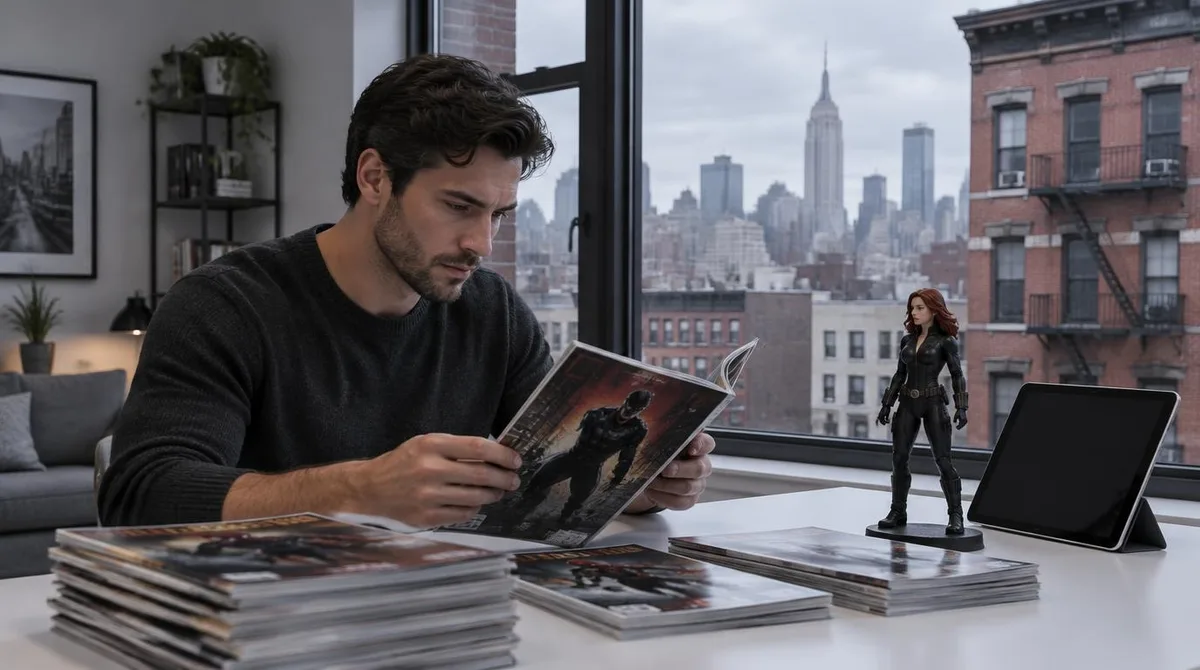
The biggest comic book romance Netflix's Daredevil skipped is Black Widow. Per SlashFilm, Natasha Romanoff debuted in "Daredevil" #81 back in 1971, stayed as Matt Murdock's partner until issue #124, and even shared the title for a stretch — yet neither the Netflix series nor "Daredevil: Born Again" has ever brought her to Hell's Kitchen. That omission says a lot about how the live-action side of Marvel gets built.
It's not a creative blind spot so much as a structural one. The Netflix show ran on a TV budget inside a separate studio division, and the MCU's Black Widow started life as an Avenger, not a street-level vigilante. Charlie Cox wanted the pairing — he told ComicBook.com in 2022 that a Daredevil and Black Widow team-up is "really funny and sexy at the same time" — but the pieces never lined up on screen.
For comics readers, the missing relationship is the whole story. For everyone else, it's a useful window into why the screen version of animation and comics canon always picks and chooses. Here's what the pairing actually was, and why both shows passed on it. Readers following this should also see Animation vs Live Action: Why Studios Make the Switch.
How big was Daredevil and Black Widow's comic history?
Bigger than most screen-only fans realize. According to SlashFilm's accounting, Black Widow debuted in "Daredevil" #81 in 1971 — well over 80 issues before Elektra existed. She stuck around as Matt's romantic and crimefighting partner through issue #124, and from issues #92 to 107 the series was literally retitled "Daredevil and the Black Widow."
Writer Gerry Conway, speaking to Back Issue magazine in 2008, said he was "looking for a way to re-energize" the book, and that a romantic and professional partnership "seemed like a natural." Her first appearance has her saving Daredevil from drowning — a fitting mission statement. Conway even moved Matt and Natasha to San Francisco for a stretch, because New York "seemed to be getting pretty crowded."
The pairing outlived its own run. Frank Miller's first drawn issue, #158, features Black Widow in a supporting role, and he brought her back for issues #187-190, where she helps fight the Hand. Issue #188, "The Widow's Bite," is told mostly from Natasha's perspective. She also turns up later in Kevin Smith and Joe Quesada's "Guardian Devil."
Why does the pairing work on the page?
Because Natasha operates on Matt's frequency and above it at the same time. SlashFilm highlights Brian Michael Bendis and Alex Maleev's arc "The Widow" (issues #61-64), where Natasha hides in plain sight at Daredevil's side after a Bulgarian official demands her extradition. The arc reconciles her spy past — she is, by training, a manipulator — with her history with Matt.
The best detail from that arc is Matt's enhanced hearing. He describes her heartbeat as one that "never skips or jumps or accelerates," the heart "of a woman whose entire body is a self-crafted instrument of deception." Then the kicker: "it's one of my favorite sounds in the entire world." That's the relationship in one exchange — trust, suspicion, and affection tangled together.
Why couldn't the Netflix show make it happen?
Money, mostly. As SlashFilm puts it, Netflix's "Daredevil" "would've never been able to afford Scarlett Johansson for a guest appearance, let alone a recurring role." A series lead from the highest-grossing film franchise on the planet doesn't drop into a streaming show for a cameo.
There was also a corporate wall. Jeph Loeb's Marvel Television, which produced the original run, "maintained a strict border with Marvel Studios," per SlashFilm. So even if the budget had worked, the rights-side plumbing didn't. In the MCU, Natasha debuted as an Avenger in "a world of gods and monsters," while Daredevil fought street-level crime in Hell's Kitchen — different planes of the same universe.
What about Born Again?
Don't expect a rescue. "Daredevil: Born Again" is produced by Marvel Studios, which removes the corporate border problem — but the character herself is gone. Natasha died in "Avengers: Endgame," and SlashFilm notes it's "exceedingly unlikely" she'll ever hook up with Matt or Bucky Barnes on screen.
Her romance with Bucky was cut from the films too, even though both characters appeared in them. That's the pattern: the MCU keeps the characters and drops the relationships. For a viewer deciding what to watch, it means the comics remain the only place the full Matt-and-Natasha story exists. This connects to our earlier piece, 5 Animated Shows Comics Readers Should Watch Next.
What does the omission actually tell us?
It's a case study in how adaptations prioritize. The screen Daredevil built its identity around Karen Page and Elektra, both of whom the comics gave him too. Black Widow got left out not because she doesn't fit Daredevil's world, but because she'd already been assigned to a bigger one.
The likely implication for future Marvel screen projects: street-level and cosmic tiers will keep running in parallel, and comic relationships that bridge them will keep falling through the gap. If you want the version where Daredevil and Black Widow share a title, a city, and a heartbeat, the issues from #81 onward are still there waiting.