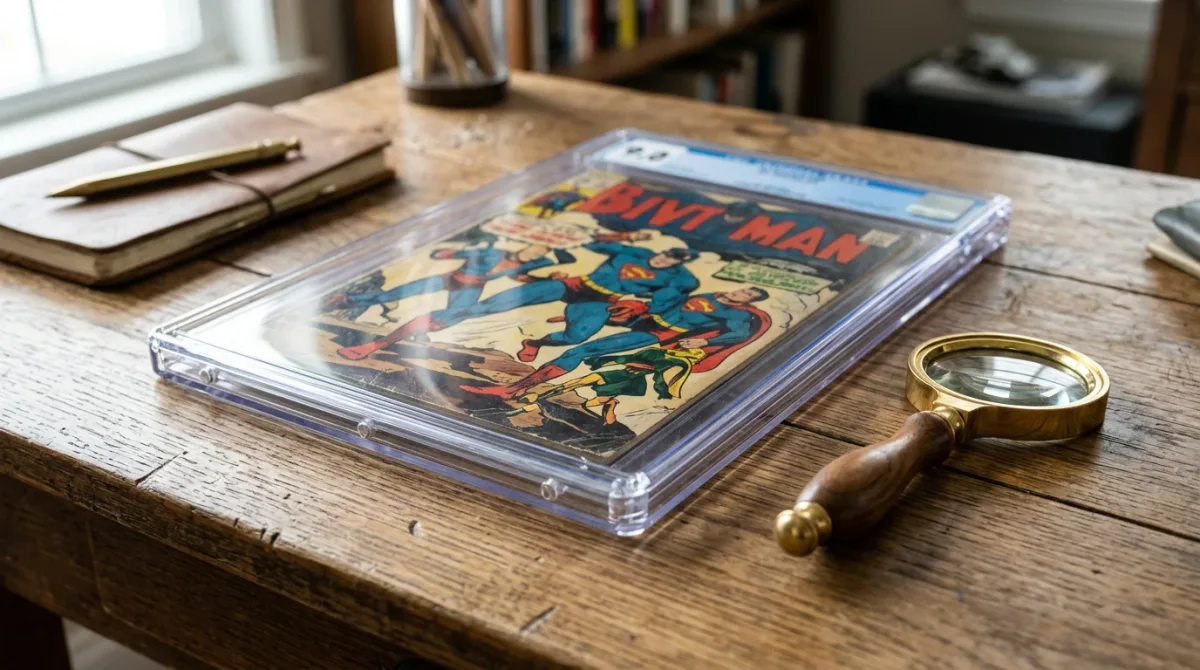
A CGC grade is a number from 0.5 to 10.0 that scores a comic's physical condition, not its story or rarity. Per CGC's published grading scale, the top of that range, Gem Mint 10.0, requires no evidence of any manufacturing or handling defect at all, while a 9.8 one step down allows only negligible wear, and every grade below that is defined by an accumulating list of specific flaws.
That distinction matters more than most new collectors expect. Two copies of the same issue can look identical to the naked eye and still land a full point apart, because grading isn't a vibe check. It's a defect count, run against a published standard, by a third party who has never met the person who mailed the book in.
What do the numbers on the scale actually mean?
CGC's scale runs from 0.5 (Poor) to 10.0 (Gem Mint) in graduated steps, and each step has both a name and a written definition of what's allowed at that grade. A 9.4 (Near Mint) is described as "a very well-preserved collectible with minor wear and small manufacturing or handling defects," while a 9.0 (Very Fine/Near Mint) allows "a number of minor handling and/or manufacturing defects" before eye appeal starts to slip. Here's how a few key points on that scale compare, per CGC's grading scale:
| Grade | Name | What it allows |
|---|---|---|
| 10.0 | Gem Mint | No manufacturing or handling defects of any kind |
| 9.8 | NM/M | Negligible handling or manufacturing defects |
| 9.4 | NM | Minor wear and small defects |
| 9.0 | VF/NM | A number of minor handling or manufacturing defects |
| 8.0 | VF | A moderate defect or an accumulation of small defects |
| 6.0 | FN | A major defect plus some smaller defects |
| 4.0 | VG | Multiple moderate defects |
| 2.0 | G | Numerous moderate-to-major defects from extensive handling |
The full scale runs in half- and quarter-point increments between those, which is why two books that both look "pretty clean" can still come back as a 9.2 and an 8.5. The grader isn't rounding up for a good first impression.
What separates a 9.8 from a 9.4 if both look near-mint?
At the high end of the scale, the gap between grades comes down to things easy to miss in hand: a soft corner tip, a faint color-breaking crease along the spine, a slightly off-center staple. CGC's scale defines 9.6 as allowing "several minor manufacturing or handling defects" where 9.8 allows only defects that are "negligible," a narrower bar that a magnifying loupe and consistent lighting are built to catch and a casual read-through is not.
Page quality factors in too. CGC assesses paper color on a separate scale running from white through off-white, cream, tan, and brown, and brittleness can cap the maximum grade a copy is eligible for no matter how sharp its corners are. A visually flawless 1970s book with browning interior pages simply cannot hit the same ceiling as a white-paged copy of the same issue.
What are grader notes, and why do they matter more than the number?
Every certified comic gets a grade, but many also get grader notes: a written record of the specific defects a grader logged during evaluation. Per CGC's grader notes guide, these are organized into categories covering creases, distortions, missing parts, stains, added foreign material like tape or writing, tanning, and tears, and CGC has historically flagged especially significant issues, such as tape, added staples, or detached pieces, directly on the certification label rather than burying them in the grade alone.
That's the detail worth checking before buying a graded book rather than trusting the number by itself. A 9.0 with no meaningful grader notes and a 9.0 with a noted spine split are the same grade and very different objects, and the notes are typically viewable for free through CGC's online certification lookup.
Does restoration change the grade?
Yes, and it's tracked separately from the base grade. Restoration is evaluated on its own quality scale (A through C) and quantity scale (1 through 5), covering things like color touch-up, piece fills, and structural repairs, per CGC's published grading standard. A restored comic isn't automatically downgraded to a low number, but it is labeled as restored, which is exactly the information a buyer needs before comparing its price to an unrestored copy of the same issue.
Why do collectors bother grading and slabbing a comic at all?
Grading exists to put an agreed-upon, third-party number on condition so buyers and sellers aren't relying on a seller's own description. CGC president Matt Nelson has described the process as certifying "the value and authenticity of a comic right upfront" and adding it to the company's public registry, according to Den of Geek's reporting on the grading process. The sealed holder, often called a slab, also protects the book physically, which is part of why graded copies are common for display pieces and high-value back issues rather than every book in a long box.
None of that makes grading a requirement for reading or collecting comics. Plenty of long runs are perfectly enjoyable, and perfectly valuable to their owner, raw and out of the bag. It's a tool for the specific moment when condition needs to be provable to someone else, not a verdict on whether a comic is worth owning.
For a related reviews perspective, read What Does a CGC or CBCS Grade Actually Mean?.
For more context, read What Does CGC 9.8 Actually Mean? Comic Grading, Explained.