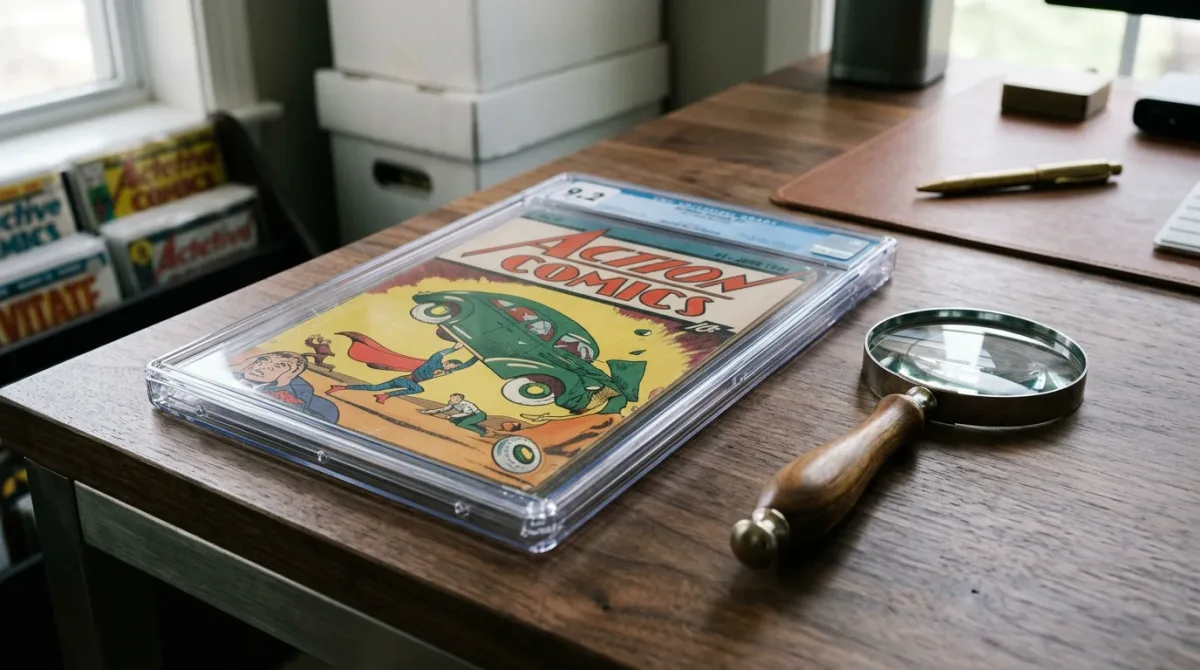
A CGC or CBCS grade is a number from 0.5 to 10.0 that a third-party service assigns to a comic's physical condition after inspecting it in person, then locks inside a sealed plastic case so the grade travels with the book. The higher the number, the closer the copy is to how it looked coming off the printing press.
If you've shopped for back issues online, you've seen the shorthand: "CGC 9.8," "raw," "NM/M." It looks like a secret code, but it's really just a condition report from a company that has no stake in whether you buy the book. Here's what the numbers are measuring, who's doing the measuring, and where the report stops telling you anything useful.
Who actually assigns the grade?
Two companies dominate comic grading: Certified Guaranty Company (CGC) and Comic Book Certification Service (CBCS). Both are third-party services, meaning they don't buy, sell, or own the books they grade — a seller or collector submits a comic, graders inspect it, and the company returns it sealed in a hard plastic holder with a grade printed on the label.
CGC uses what it describes as an industry-standard 10-point scale running from 0.5 (Poor) up through 10.0 (Gem Mint), per the company's published grading scale. CBCS runs a comparable certification service and also operates a Verified Signature Program for autographed books, according to CBCS's own site. The two companies compete directly, but the underlying idea — an independent inspection sealed into a permanent record — is the same.
What actually determines the number?
Grading isn't a single measurement; it's an assessment of the whole physical object. Per CGC's published scale, graders weigh manufacturing and handling defects, wear patterns, and structural integrity, then fold in a separate page-quality read that runs from white paper (minimal aging) down through tan and brown, with brittleness capping how high a grade a book can reach no matter how clean the cover looks.
A 10.0 Gem Mint is reserved for a copy CGC states shows no evidence of any manufacturing or handling defects at all — vanishingly rare on anything printed before shops started bagging new comics on the rack. A 9.8 ("NM/M", Near Mint/Mint) is the grade most collectors chase for modern books: nearly perfect, with only negligible flaws. Below roughly 5.0, the scale is describing a reading copy — real wear, maybe a crease or a small tear, still complete and collectible, just not a shelf trophy.
Does restoration lower the grade?
Restoration is graded and disclosed separately rather than folded silently into the main number. CGC's scale documentation describes separate quality and quantity assessments for restoration work — how much material was used, how extensive the piece-fill or color touch is — and distinguishes conservation (stabilizing the paper) from cosmetic restoration (making it look better). A restored book gets a purple label instead of a blue one, so the work is visible on the holder, not hidden inside a grade that looks identical to an untouched copy's.
Does a high grade mean a book is rare?
No — and this is the part collectors most often get backwards. Both companies publish population data: CGC's Census / Population Report lists how many copies of a given issue the company has graded at each grade level, broken out by publisher, title, and issue number. It's a real, useful number for gauging how many high-grade copies of a book are floating around relative to other issues.
But CGC is explicit that population counts are not a value or rarity indicator, per the company's own Census / Population Report page. The report states plainly that its data "only reflect the quantities and types of collectibles previously graded" and are provided for hobbyists' informational use only — not for making a purchase or investment decision. A low population count can mean a book is genuinely scarce, or it can just mean collectors haven't bothered submitting their copies yet. The report tells you what's been graded, not what exists, and it definitely doesn't tell you what a book is worth.
Is a graded slab safe to open?
Most collectors don't, and that's the point. The sealed holder exists so the grade stays attached to a specific, physically verified copy — cracking it out to read the book means the grade no longer applies to what's inside if you ever want to sell it. If you want a reading copy, buy raw (ungraded) and keep the slabbed book as the shelf piece. There's no rule against cracking a slab; it just resets the condition clock the moment you do.
Should you get your own comics graded?
Grading makes the most sense for books you're planning to sell, insure, or keep permanently sealed away from handling — a key first appearance, a signed convention exclusive, a childhood copy you never want touched again. It makes less sense for a long-box full of reading copies you're going to reread; submission costs money and time, and a graded 6.0 isn't worth more to you than the same book raw if you're just going to enjoy it. Start with the books that actually carry resale or sentimental weight, not the whole collection.
For a related collecting perspective, read What CGC's 10-Point Comic Grading Scale Actually Means.