Comic book fandom organized itself, decades before the internet made organizing easy. The first comic book convention took place in New York in July 1964, drawing roughly one hundred fans; sixty years later, San Diego's convention alone fills its venue past 130,000 attendees per the event's own reporting. In between stands a continuous, self-built culture — fanzines, awards, clubs, shops and conventions — created almost entirely by readers rather than publishers. This is the short version of how that happened, and why it still shapes the way comics work.
What came before organized fandom?
Letters. From the 1940s onward, letter columns printed readers' names and addresses, and enterprising fans used them to find each other. That postal network mattered: publishers discovered their audience included articulate adults who remembered Golden Age titles from the 1930s and 1940s — a realization that fed the reprint boom and, eventually, the collector economy. The institutions that collect and study this material today, like the Library of Congress's cartoon and comic art collections, exist partly because those early fans saved what the industry threw away.
How did the fanzine era build fandom?
In 1961, fans Jerry Bails and Roy Thomas launched Alter Ego, the fanzine that gave comics fandom its voice — hobbyist research, interviews, market notes, all mimeographed and mailed. Around it grew the apparatus of a real subculture: the Alley Awards, fandom's first regular fan-voted prizes, begun in the early 1960s; regional clubs; and an economy of apa (amateur press alliance) mailing loops. Fanzines trained a generation in criticism and editing, and several fanzine hands, Thomas included, turned professional. The pattern — fans building the institutions publishers would not — became fandom's defining trait.
What happened at that first 1964 convention?
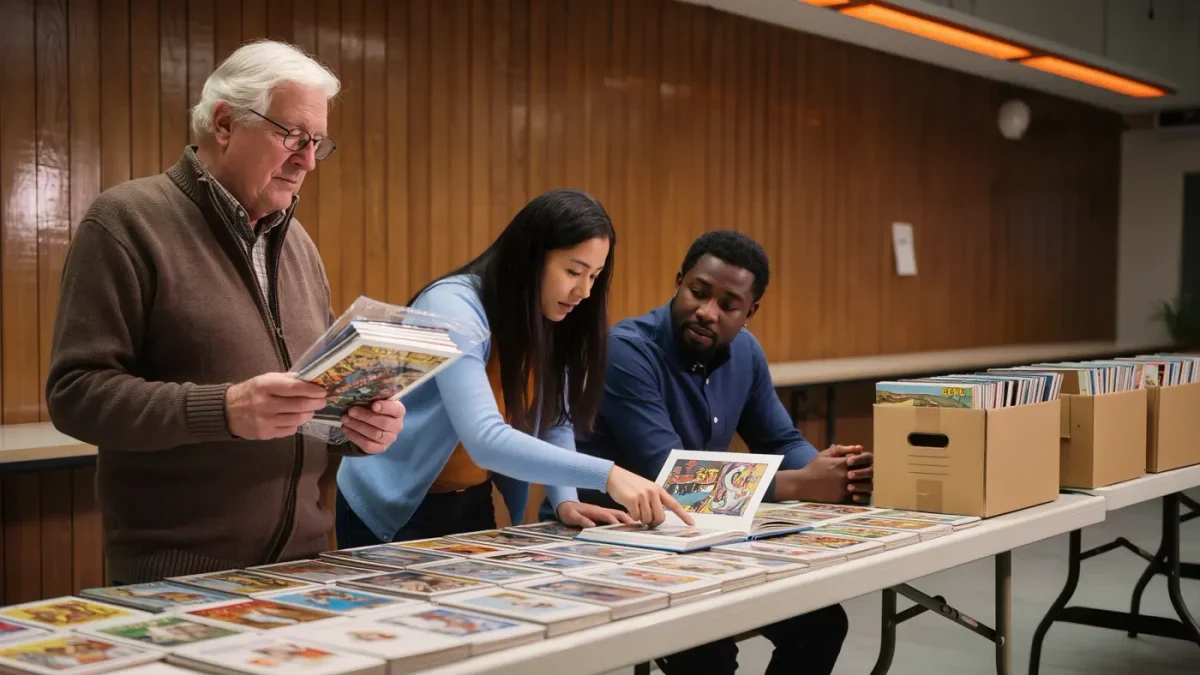
About a hundred fans gathered in New York on July 27, 1964, for what is generally credited as the first comic book convention: dealer tables, panels, and creators honored as guests rather than celebrities at a distance. The template scaled relentlessly — New York's own convention grew into a arena-filling event, and San Diego's, founded in 1970 as a small regional show, became the global pop-culture juggernaut whose panels and exclusives now anchor entertainment industry calendars. Every convention you will ever attend descends from that room.
How did comic shops change fandom?
Profoundly, by giving fandom a place. When the direct market took shape in the early 1970s — retailers buying non-returnable stock from publishers — comic shops became the first physical gathering points for fans, doubling as clubs, bulletin boards and back-issue markets. The 1980s and 1990s added the collecting infrastructure fans now take for granted: third-party grading emerged in 2000 with CGC's launch of its 10-point encapsulation standard, professionalizing a collector market that fanzine readers had run informally for decades. Fandom stopped being a correspondence network and became a retail culture with a weekly ritual — new-comic day.
What did the internet do to fandom?
Speed, scale and schisms. Early online communities in the 1990s moved fan discussion to Usenet newsgroups and forums, collapsing the fanzine's month-long feedback loop into hours. The 2000s and 2010s brought creator-access social media, crowdfunding platforms that let fans directly fund creator-owned projects, and fan-run news sites that often outpace trade coverage. The gatekeeping function old fandom prized — curated indexes, awards, archival expertise — now competes with raw volume. What survived is the founding instinct: fans documenting, preserving and organizing around the medium faster than any institution does.
Why does this history matter to a reader today?
Because nearly everything you interact with as a comics reader was fan-built. Conventions, awards, back-issue markets, grading standards, archives, the very expectation that publishers should respect continuity and history — all trace to readers who decided the medium deserved infrastructure and built it themselves. The Library of Congress's public cartoon and comic collections, which preserve the art old fans rescued from pulping, are the institutional end of that same story. When you join a pull list, argue canon, or walk a convention floor, you are using infrastructure that began with mimeograph machines and letter columns. Fandom was never the audience of comics. It was, and remains, part of the machine that keeps them running.