Catching an out-of-print comic on its way back into print is a learnable skill: reprints follow predictable triggers — anniversary years, screen adaptations, and publisher archive programs — and every one of those triggers is visible months before the solicitation drops. As of May 2026, the reprint pipeline runs through the same monthly catalogs as new books, which means the information is free and public. This guide covers the triggers to watch, the signals a reprint is coming, and the buy-or-wait decision when a book you want is dark.
Why do out-of-print comics come back?
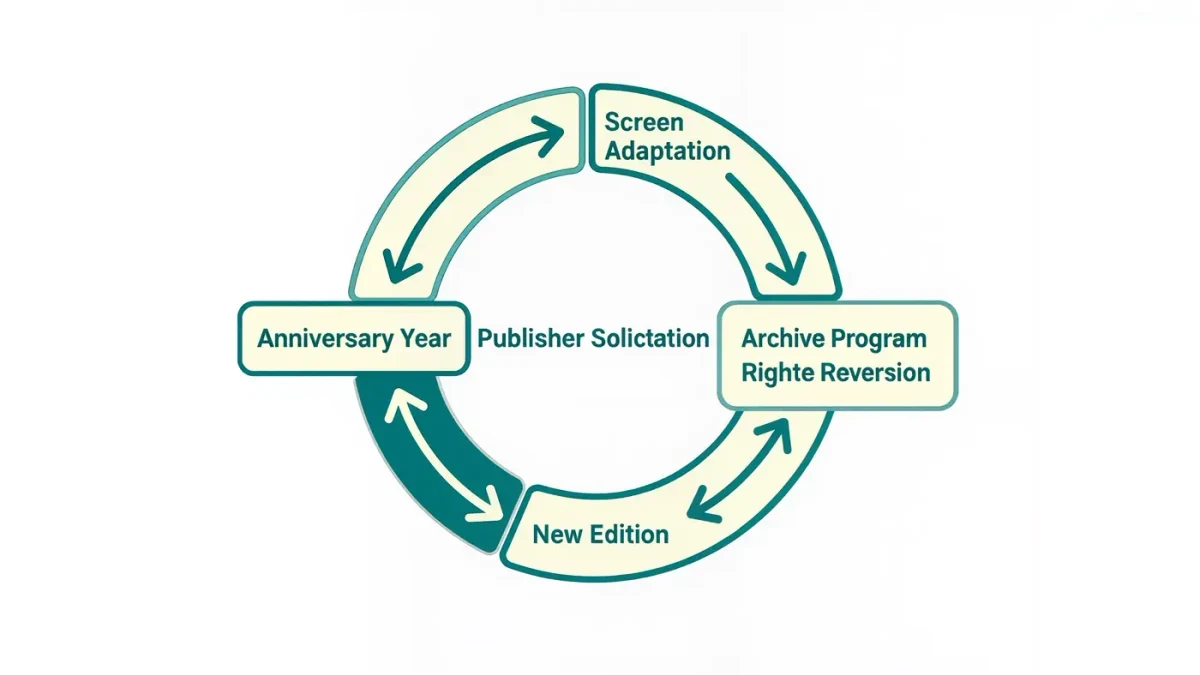
Three engines drive nearly every reprint. Anniversaries: publishers mark milestone years of landmark runs with restored hardcovers — the contents are usually identical to earlier editions, the format is upgraded. Adaptations: when a studio adapts a comic, the source material returns to print fast, because new readers search for the book the show came from. Archive programs: publishers increasingly treat their backlists as living catalogs, re-issuing lapsed material in uniform editions. A fourth, quieter engine: creator-rights reversions, where a creator regains a lapsed license and brings it to a new publisher.
What signals a reprint before it's announced?
- The book's price climbing on the secondary market — demand publishers notice.
- An adaptation in production for the property — the single strongest predictor.
- A round-number anniversary within the next 18 months.
- The publisher releasing adjacent material from the same era or imprint.
- The current edition's listing quietly going 'unavailable' rather than 'out of print' — sometimes stock, sometimes a reset before a new edition.
Any two of these together and a reprint within two years is a reasonable expectation. All of them, and you should probably just wait.
How do you confirm a reprint is real?
Only one way: the solicitation. Publisher catalogs list new printings with new ISBNs, contents lines, and dates — and only a catalog listing converts hope into a street date. Convention announcements and social posts by creators are strong hints, but comic publishing history is a graveyard of announced reprints that slipped a year. Wishlist it, set a note, and pre-order when the solicitation appears. Not before.
Should you pay secondary-market prices while you wait?
Almost never, with one exception. The exception is a book with no visible reprint path — no anniversary, no adaptation, no archive program — where the choice is secondary market or nothing. Even then, set a ceiling before you search, because auctions punish the unprepared.
What should you check when a reprint finally ships?
- New ISBN or same printing? A new ISBN means a new edition — check the contents line for changes, restorations, or extras.
- Format upgrade or parity? Anniversary reprints often move from paperback to hardcover; if you own the old softcover, that's a double-dip decision, not an automatic buy.
- Trim and paper. Reprints sometimes shrink the trim size to standardize a line — check the solicitation's dimensions if shelf-matching matters.
- First-printing window. Reprints of cult books can mirror debut dynamics: conservative first run, fast sell-through. If you want it, the pre-order rule applies again.
How do you track a whole wishlist of dark books?
Keep a simple list — title, publisher, what triggers a reprint (anniversary year, adaptation status), and a check-in frequency of once a quarter. Skim that publisher's solicitations quarterly for your titles. That's the entire maintenance cost. The discipline pays twice: you stop overpaying for books that are coming back, and you're first in line when they do. Reprint watching rewards patience more than money — which is exactly why it's the most collector-friendly game in comics.
What role do libraries play while you wait?
A bigger one every year. Public library systems stock graphic novels deeply — often through vendor programs built specifically for comics — and interlibrary loan extends your reach to books your local branch never bought. For reprint-watchers, the library solves the reading problem while you skip the paying problem: you can read the dark book now, free, and buy only if and when a reprint arrives in a format you want. Library catalogs are also informal availability sensors — a wave of hold queues on an older title is the same demand signal publishers watch. One caution: library availability doesn't predict reprints by itself, because libraries also replace damaged copies of in-print books. It's evidence, not confirmation — like everything else in this game, only the solicitation closes the case.
How long is too long to wait?
Set a review horizon — say, two years from your first trigger sighting — and re-evaluate rather than stewing. If two solicitation cycles pass with no movement after strong triggers, the honest read is that the publisher doesn't currently see the business case. Then the decision becomes explicit: buy at the ceiling price you set, borrow through a library, or shelve the want. An explicit decision beats an open-ended wait, because open-ended waits curdle into resentment of books that owe you nothing.